Saturday, October 29, 2011

A Drop in the Bucket

Fish mortality associated with irrigation ditches is a problem throughout the West. In Montana alone it is probable that hundreds of thousands, if not millions of fish (not all are trout) perish in irrigation ditches on an annual basis.

Trout Unlimited is working to raise funding for, and install screening on irrigation ditch headgates, but progress is slow. Additionally, many regional TU chapters are hosting events in cooperation with landowners to rescue fish stranded in irrigation ditches.

A fishing buddy and I recently held our own unsanctioned fish rescue on the irrigation ditch that runs by my house. This ditch diverts water from the Gallatin River, and likely claims the lives of thousands of fish every year. In about two hours of work with a boat net, a bucket and a sheet of window screening we managed to rescue nearly 100 fish. Many of them were fingerling whitefish, but a number of them were fine brown trout that belong in the river.

Our efforts were just a drop in the bucket, but every bit helps. Contact your local TU chapter to learn more about opportunities to get involved.

Monday, October 10, 2011

Pleasant Pheasant Surprise


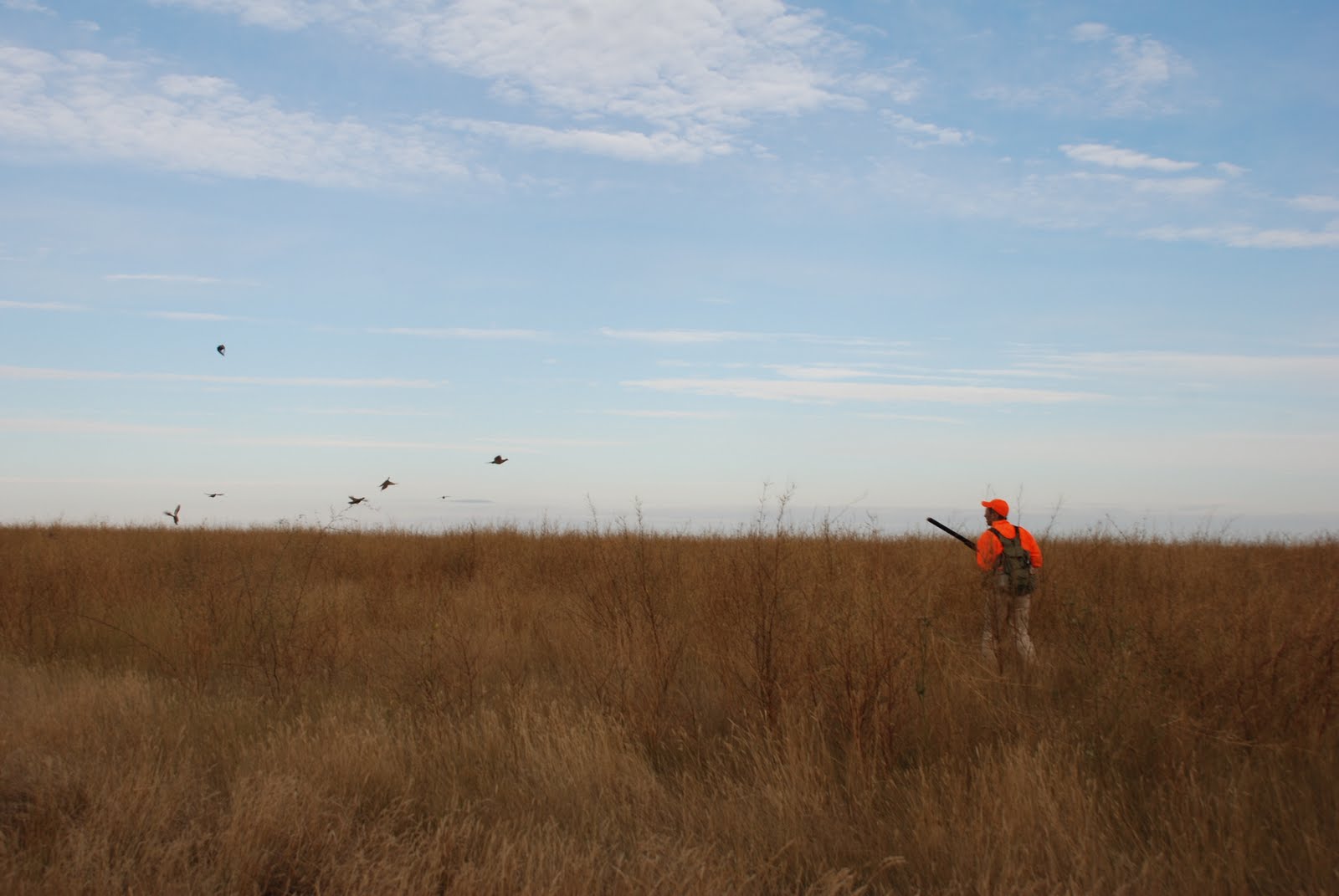
Most of us Montana bird hunters headed into the 2011 pheasant season with lowered expectations. Winter was pretty brutal, as it started early and lasted until April, without a lot of reprieve throughout. When spring did arrive, the state was saturated, with above average rainfall and a fair amount of lowland flooding. It was an unfortunate “perfect storm” scenario.

However, thirty minutes into the opener, I commented to Ryan that there were enough birds to hunt this fall, despite the negative outlook by wildlife biologists, farmers and hunters. By ten o’clock, when we had our limit of six roosters, I upgraded my description from “enough” to “average numbers". In one field alone, we moved probably 50 birds in a mile-long walk. However, there were areas that were fairly void of birds, but typically have held pheasants in the past. Over the course of the weekend, we did put on a few fruitless miles too. But, overall, there was plenty of action and good dog work.

The trade off for more birds than expected, was the quality of the birds. According to Ryan’s dad, who is a rancher and spends a good amount of time on the land, many pheasants had an unsuccessful first hatch, but managed a very successful second hatch, due to the lush grass that developed. Since many of the late hatches occurred around August 1st, the evidence was present this opener. We saw pheasants that would cackle like a rooster, but had no coloring whatsoever. One flock of pheasants were the size of Hungarian partridge. We vowed to select only the mature roosters over points by the dogs, but despite the attempt, we still ended up with a few young birds.

It was a pleasant surprise to see what Mother Nature can giveth after she taketh away so much during winter and spring. It should make for some decent hunting longer into the season. Let’s hope that winter doesn’t arrive early this autumn.

Sunday, September 18, 2011

Good Year For The Blues


Most of Montana had a wet, extremely wet, spring. As a bird hunter, we worry about the spring hatch as much as we worry about getting water in our basement. One thing I am learning is that the spring weather on the low ground, the stuff that adversely effects grouse, partridge and pheasants, may not be as detrimental to the mountain grouse populations.
In fact, we have seen some very nice broods this fall and a lot of them. It doesn't seem to matter what mountain range we hunt, what the weather is that day or what our horoscopes say; this is shaping up to be one of the best falls for chasing blue grouse up high.
But, there is one caveat to keep in mind before grabbing the shotgun and heading up in the hills: You will need to hunt hard and hunt high. Most of our birds have been above 7,000 feet and our daily jaunts have been pushing 10-12 miles.
As a result of the good fortunes up high, I have delayed most of my trips locally to look for Huns and sharptail. Those birds can wait, however. By late September, planning any trips to hunt blue grouse can get dicey. Snow comes early to the high country, making travel and hiking more difficult, if not impossible. Then, it is prairie birds or nothing. Let's hope they had a better-than-expected hatch too.

Tuesday, September 6, 2011

Birds and Dogs On The Front

Since I wasn't as fortunate as some of the bird hunters I know, I didn't get to hunt the opener on September 1st. But, thanks to an invite from Shoco Ranch, I was hunting Saturday morning in some of the most beautiful country around.

Shoco is located just outside of Augusta, along the Rocky Mountain Front.Shoco is an oasis amidst mostly dry cattle country, with good bird habitat along a gem of a little trout stream. The fourth-generation owner of the ranch, Sally Shortridge, now manages the ranch for birds and also releases pheasants and chukars. Not truly wild birds, but you wouldn't know as you never see a pen of caged birds on the place and they fly as strongly as any game bird I have hunted.

Sally was a good host, as we hunted over both her German shorthair and my setters. (Guess which dogs required an hour of combing and grooming that evening) The dog work was good, the shooting decent and we finished the evening at a campfire at one of the three rustic, secluded cabins along the creek.


The next day Laura and I decided to trade the shotguns for fly rods and did a little fishing. The early September day was prime hopper time and Laura landed her first brown on a Joe's hopper. The creek held good numbers of fish and there were more deep runs than we could get to in a weekend. I really couldn't think of a place I would rather have been.

Sunday, August 21, 2011

Trout Up High


If you read Montana Sporting Journal, you know that we often tout Montana's great mountain lake fishing. The season is very short, the list of potential lakes to fish, so lengthy. While I am one the folks bragging up these little-fished resources, I hadn't yet been up in the mountains this summer to hike and fish.
That finally changed this weekend. Laura and I didn't have much time, just two days and one night to work with. Regardless, it was ample time to grab a pack, lightweight camping gear, and just the essentials out of my fly vest and head for the hills.
Upon arrival, the trailhead near Red Lodge was bustling with activity, which is always unexpected. Vehicles from five states, horse trailers and a couple of large vans, probably hauling groups of people were all present. However, there is no need to fret, as it is never crowded once you are a few miles into to bush. In fact, 1/3 of the people were within the first three miles of the trailhead and the horse trailers were for hauling mules to work on rebuilding parts of the trail.
The most difficult decision was to decide which lake to fish. Laura and I had six lakes to choose from, all around 10,000 feet, some of which held cutthroat, the others had brookies. We picked a lake that held both, but lacked a well-marked trail from the "base camp". The extra work would pay off, as we had the lake and its afterpool to ourselves. The fish were smaller than I had hoped, but with many of these mountain lakes, it is all about the timing of the stocking and growth rates. Two years from now, the fish in this alpine gem will be beauties.
We fished until mid-afternoon, packed three gutted trout into a Nalgene bottle packed with snow, and headed back downhill.
Once again, the time in the mountains was rejuvenating. It is always remarkable how you can be at snow level at noon and be back in Billings a few hours later where the temperature is pushing 90 degrees (Friday night in camp, water in the dog dish froze). The scenery never gets old and with a little bit of effort, you are rewarded with a little bit of heaven.

Friday, July 22, 2011

Finally Fishable


July 4th was my guess. Today is July 22nd. A couple of months ago, during "the flood", we all took bets on when our local creek would be clear enough to wet a line. This evening, there was finally enough clarity to commence the 2011 fly fishing season on Spring Creek. Was it crystal clear? No. Good enough to make you feel like you had a chance at a trout that hadn't seen anything man-made for 9 months? Yes.
It has been an amazing year in Montana. Fly shops were selling more coffee to locals than flies and t-shirts to clients. The major tailwaters, the only options for weeks, were beaten to a froth with fly casters, but still awfully productive. This week we finally heard of some near normal conditions on the Big Hole, Upper Madison and other rivers. A lot of time has been lost this year. Bitterroot Skawla frenzy? Brief. Mother's Day Caddis hatch on the Upper Yellowstone? Skipped. Hoppers on the lower Yellowstone? Let's hope so. That big girl is still running high.
My fishing tonight was decent. Not a banner evening, but not too bad. The grass along the banks was waist high, the mosquitoes were running eight or so to the pound. These are the results of a wet spring. When the creek was sprawled out this spring, covering acres of ground and flooding basements, I couldn't help but wonder about the trout. Are they eating more? Are they not feeding at all, just dodging sticks and garbage, sitting on the bottom? Well, they are still there, acting like trout, fighting like trout and occasionally frustrating me like trout. Regardless, it is nice to have our old friend back.
For those of you that have been emailing, wondering if it was worth a drive up here to fish and buy me supper (Will, Spartas, Bryan Attwell, et al), come on up. It is time.

Tuesday, July 5, 2011

Friends, Fishing and the Fourth


Typically in late June, early July, I am usually still chasing walleyes on Montana reservoirs, but this summer, with the lack of fishable trout water, makes it nearly a necessity. Granted, the boat ramp was completely under water and part of the campground was also damp, but our Fourth of July plan sounded like a good one.
While I expected a good walleye bite, I didn't expect to see eight species that were all on the feed this holiday weekend. Between the four of us, we netted walleye, northern pike, smallmouth bass, crappie, perch, sauger, and the less desirable, drum and goldeye. We each had our personal glory over the course of three days. Mike landed his biggest walleye to date, a feisty five pound fish that came out of six feet of water. Scott pulled in a smallmouth that topped four pounds. Laura finessed the most walleyes, some of which provided a nice fish fry Saturday night. And I led the group in song and played my guitar as we enjoyed the fire. Actually, we just enjoyed the fire.
Once again, I made the drive home, reflecting on how fortunate I was to live in this great state. The fishing pressure was light, despite it occurring during a busy weekend, the weather was spectacular and the fish, a true smorgasbord of riches, cooperated. What a great Fourth of July, what a great country and what a great state.

PS. Don't judge Scott by his hat. He is actually fairly sophisticated and worldly, but after two days of sun, he was desperate for shade.